Review of the first trilogy:
~ Dragonflight | Dragonquest | The White Dragon ~
Anne McCaffrey's ongoing Dragonriders of Pern series consists of two trilogies, two chronicles, and sixteen related books. McCaffrey began the series in 1968 with a short story which became Dragonflight. Her son Todd McCaffrey is continuing the saga with Dragonheart published in 2008 and Dragongirl due out in mid-2010.
According to the publishers, the books can be read individually or as a series. I've reviewed the first three books below.
The titles in recommended reading order:
Dragonflight | Dragonquest | The White Dragon (Dragonrider Trilogy)
Dragonsong | Dragonsinger | Dragondrums (Harper Hall Trilogy)
Moreta: Dragonlady of Pern | Nerilka's Story | Dragonsdawn |Renegades of Pern | All the Weyrs of Pern | The Chronicles of Pern | The Dolphins of Pern | The Girl Who Heard Dragons | Second Chronicles of Pern | Dragon's Eye | Masterharper of Pern | The Skies of Pern | A Gift of Dragons | Dragon's Kin | Dragon's Blood | Dragon's Fire | Dragon Harper | Dragonheart | Dragongirl

Dragonflight
Dragonflight opens with a fascinating female character called Lessa, the sole surviving heir to Ruatha Hold disguising herself as a servant to prevent detection by an evil invader. Because of this great beginning, I had high hopes that Anne McCaffrey would veer from what has become standard Fantasy fare: a strong, heroic male character saves a damsel in distress, feisty as she may be. So I was disappointed when Lessa continuously required saving by the irritating and arrogant Dragonrider F’lar.
Nevertheless, there was much to enjoy about Dragonflight. McCaffrey has skilfully blended Fantasy and Science Fiction, creating a world on a distant planet that had been colonised centuries before by travellers from Earth. In all this time, however, the residents of Pern have adapted to the harsh bucolic life on their planet and forgotten the science that brought them here.
Sharing their world are dragon-like creatures who must bond to a human companion at hatching to preserve the partnership that allows them to fight the scourge of the Threads that fall from the sky and threaten to drain the planet of all vegetation. However, Thread hasn’t fallen for centuries, and have dissolved into myth along with the means to combat them.
Lessa becomes the companion to the newly hatched dragon queen, Ramoth. Together with F’lar, the rider of Ramoth’s mate, she must find a way to save an unprepared Pern from the new fall of the Threads.
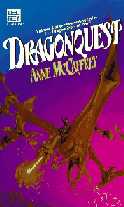
Dragonquest
*** Spoiler Warning ***
Spoilers for Dragonflight
There are some minor spoilers for the ending of Dragonflight in the following review of Dragonquest.
Dragonquest takes place seven "turns" of the planet Pern after Lessa flew back in time and returned with hundreds of dragons and their riders - redundant in their time, but eager to fly forward to the future and fight Thread again. Now, however, these Oldtimers are dissatisfied and anxious about the subtle changes that four hundred turns has wrought on Pern.
Just as unsatisfied are the Holders of Pern who govern their respective Holds, each of which is bound to one of the Dragonweyrs and responsible for providing food and supplies to the dragonriders who, engaged in defending Pern from Thread, have no time or land to provide for themselves.
The Holders were reluctant enough to take turns providing occasional supplies to one Dragonweyr in Pern; now they have to deal with the sudden appearance of seven Weyrs headed by demanding Oldtimer Weyrleaders used to respect and subservience.
Against this socio-political backdrop, McCaffrey tells the story of Brekke, partner to the second queen dragon of a Weyr, and F’nor, partner to a brown dragon. As with Lessa’s story in Dragonflight, this subplot is far more fascinating than the main story, and I was frustrated by the many pages dealing with annoying and petty politics between glimpses of a real story. The book is not made easier to read, either, with the unpronounceable character names, and scores of minor characters to remember.
The hero and heroine of Dragonflight take a backseat in this story, and yet they are used as point-of-view characters when they do almost nothing plot-wise for the entire book.
The lack of exploration of the emotions of the characters is a missed opportunity to develop reader empathy. The plot includes one tragedy and two close calls, but then skips ahead to a time when her characters can believably be expected to be, at least partially, recovered from the experiences.
Dragonquest continues the themes of dominant male/subservient female society introduced in Dragonflight. Lessa’s slightly rebellious actions at the end of Dragonflight highlight the misogyny of Pern, ingrained in even the female characters as evidenced when Lessa returns expecting F’lar (essentially her spouse) to punish her for her actions, and being relieved that he merely rebukes her. There is a romanticised rape in both books, where both times the woman is expected to accept the action as normal; desirable even.
Despite the dragon species’ matriarchal system, with the queen at the head of the Weyr, the humans of Pern don’t accept the queen’s human (female) partner as the leader of the Weyr. Instead, the male partner of whichever dragon mates with the queen becomes the Weyrleader, with the queen’s partner subservient to him as his Weyrwoman. If a different dragon catches and mates the queen, the leadership of the Weyr changes accordingly. Male dragonriders are even awarded an honorific (the apostrophication of their name) on becoming a dragon’s partner, but none of the female riders gain the name change, not even those who partner with a queen.
This duality highlights the bizarre and contradictory nature of gender issues in society given that the humans live in sync with the dragons, telepathically and physically.
The Pernese also seem to have conflicting ideas about sexuality. Pern, in the dragonweyrs in particular, is an openly sexual culture. When the dragons mate, the human partners of the dragons also engage in sex. Yet the society condemns one woman who is overtly promiscuous within this norm. Despite the fact that some of the male dragonriders have numerous casual sexual partners, Kylara’s actions are considered "adulterous" when her desires contribute to an accident.
McCaffrey's Pern series is an intriguing twist on the traditional science fiction and fantasy genres. The people of Pern have lived as rustic craftspeople and farmers for generations, passing down their skills by word of mouth. Now they are gradually discovering the science and ingenuity of their ancestors that brought those first colonists across space from Earth.
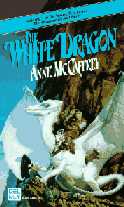
The White Dragon
The White Dragon was first published as a short story and was later lengthened by adding a number of semi-connected episodes to bring the story to book length. It gives the book a rather disjointed feeling, with the main plot wrapped up in the first third of the book and the rest of the story having little bearing on previous events. In one of the episodes the characters discover the ships, or parts thereof, used by a team of exploratory scientists from Earth, shedding more light on the origins of the society of Pern ( or P.E.R.N. Parallel Earth, Resources Negligible).
The White Dragon at Amazon.com*
Review copyright © Elsa Neal 2006
*Book Depository is a better option for non-US book buyers.
